
Running a Sex Offender Check in Hamden
Hamden does not maintain a separate county sheriff registry. Connecticut counties lack the county-government role assumed by many search systems, so the official path runs through the Connecticut public-safety service directory and the registry managed by the Department of Emergency Services and Public Protection, or DESPP. Search by a person's name when identity is the main question. Use Hamden location details when the concern is tied to a street, town, ZIP code, or nearby area. Live controls can change because the interface is dynamic.
Prepare more than a name before reviewing results. Spelling, aliases, a photograph, age-related traits, and the listed address can help separate people with similar names. A result reflects a statutory registration duty, not every past police event. Likewise, no result does not prove that no risk exists. The Hamden sex offender check is one focused public-safety source. Broader court and police questions require other official records.
Hamden Registry and NSOPW Compared
The Connecticut registry is the first source for a search centered on Hamden. The Dru Sjodin National Sex Offender Public Website, known as NSOPW, adds a cross-state layer by querying participating jurisdictions through one federal site. That distinction matters near Hamden's borders and for a person whose known location may have changed. NSOPW is useful for breadth, while Connecticut remains the primary source for its own public record and disclaimer.
The two tools should not be treated as duplicate proof. Jurisdictions publish under their own laws, update cycles, and public-field rules. A searcher should check spelling, run both name and place searches when offered, and open the source jurisdiction's profile rather than relying only on a results list. The national interface is shown in the official NSOPW search source below.
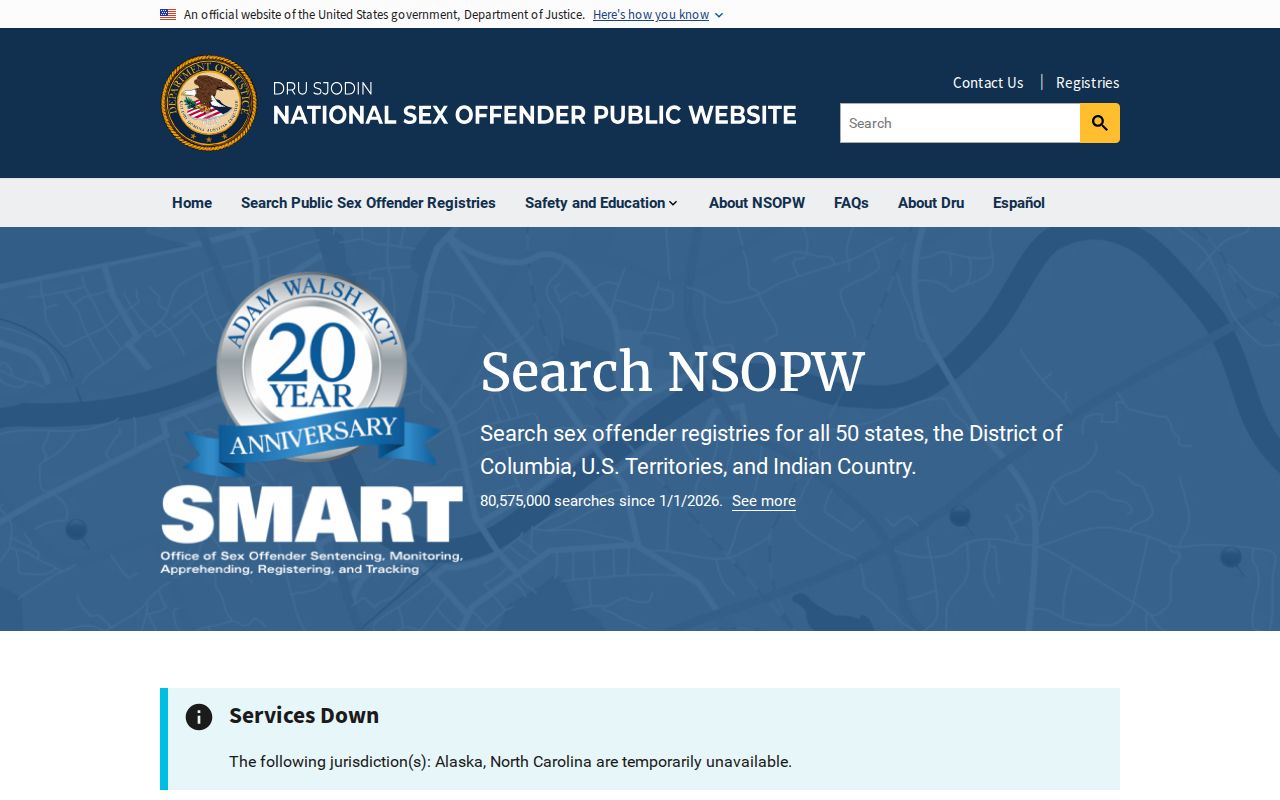
The neutral search screen illustrates the national layer without displaying or singling out a private registrant.
Searching the Connecticut Sex Offender Registry
DESPP and the Connecticut State Police Sex Offender Registry Unit manage the official Connecticut Sex Offender Registry. It covers people who have a qualifying statutory duty under Chapter 969. It is not a list of everyone arrested for a sex offense. For a Hamden search, use the live name and geographic controls that the state interface presents, then compare the result with enough identity details to avoid a false match.
- Open the registry through Connecticut's official public-safety services and read the conditions of use.
- Enter a first and last name, or use the available address, Hamden, ZIP, map, or radius controls.
- Review the list or map and compare aliases, photographs, and physical details before deciding that a result matches.
- Open the full public profile and read the offense, address, registration dates, verification details, and current status together.
| Field Label | Type | Required | Notes |
|---|---|---|---|
| First and last name | Text | Depends on search path | Spelling matters; compare aliases in a matching profile. |
| Address or location | Text | Depends on search path | Use a known address or other location detail. |
| Town or ZIP | Text or select | No | Use Hamden or a known ZIP to narrow geographic results. |
| Map or list | Result display | No | Geographic results may appear as mapped points or a list. |
| Radius controls | Geographic control | No | Use only when the live Connecticut interface offers the option. |
The Connecticut service entry provides the official route shown in this source image.
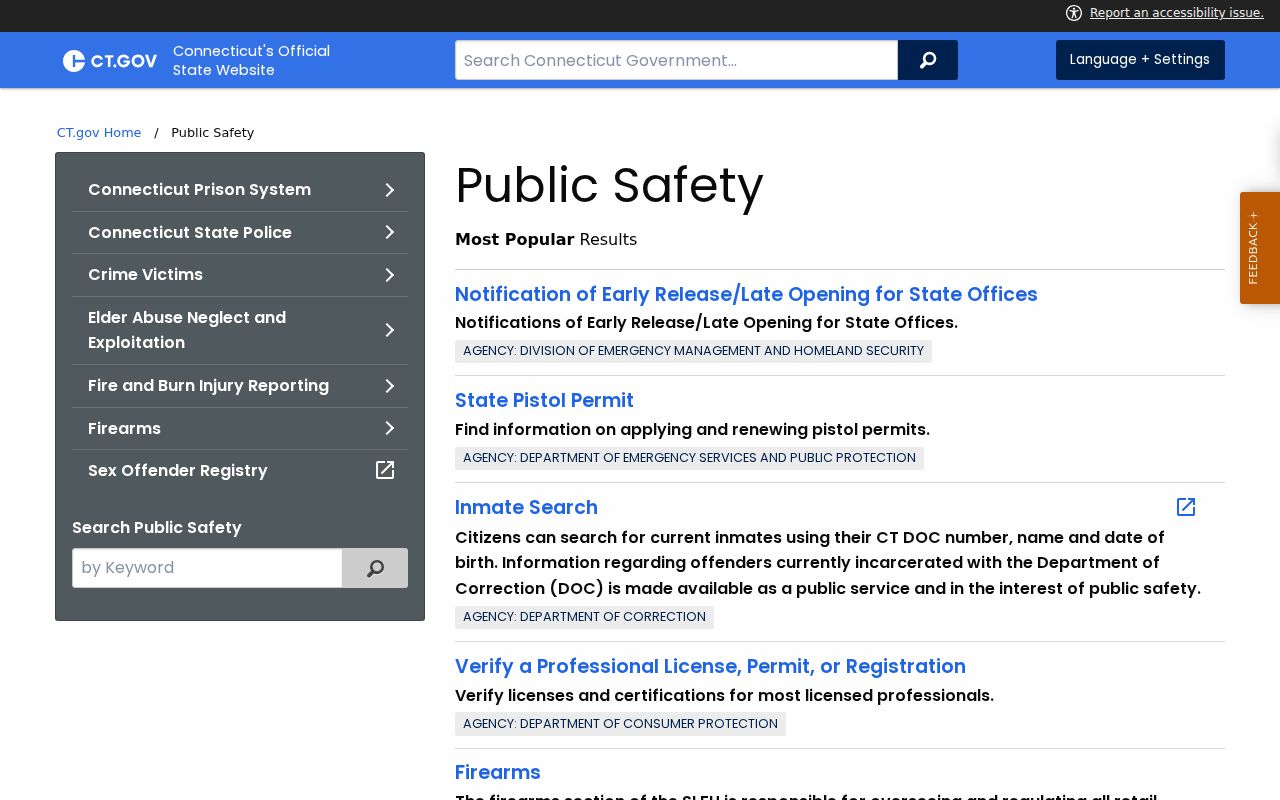
This state entry point keeps the Hamden search tied to the agency that maintains Connecticut registration data.
A Hamden Registry Absence Proves Less
A blank Hamden search is not a general background check or a safety certificate. Connecticut's registry is limited to people with qualifying duties under state law. It does not stand for the much wider universe of arrests, court cases, erased matters, or conduct that never led to a qualifying registration order. Search terms can also miss a person when a name is spelled differently or a location has changed.
Use absence as one narrow finding: the query did not return a matching public registry result at that time. Try a known alias, confirm the town or ZIP, and use NSOPW if another state may be involved. Do not turn silence in one database into a claim about a person or place. For a broader view of Hamden criminal records, the Hamden criminal history overview explains the separate police, court, state-history, and custody channels.
Note: A registry result answers a statutory registration question, while no result cannot establish that a person or location presents no risk.
What a Registry Profile Shows
A public profile combines identity, location, offense, and registration fields authorized for release. Read the full set rather than stopping at a name or map point. A photograph and physical description help with identity, while aliases can explain why one person appears under more than one name. Address and verification fields describe the registry record. They do not promise that a person is present at a place at the moment of a Hamden search.
| Name & Aliases | Published identity names that help distinguish a possible match. |
|---|---|
| Photo & Physical Description | A current or available image plus descriptive traits used for identity review. |
| Registered Address | The public address or location information authorized by Connecticut law. |
| Offense & Statute | The qualifying offense, statute, and conviction or release information when authorized. |
| Registration Dates | Dates tied to registration and address verification duties. |
| Registration Status | The status and verification information that the public interface makes available. |
| Other Identifiers | Scars, marks, tattoos, vehicles, school, or work fields only when law and the interface make them public. |
Connecticut does not promise that every possible identifier will appear. The statute and live interface control what is public. A careful Hamden sex offender check separates a field that is absent from a statement that the underlying fact does not exist.
Read Hamden Registry Profiles Carefully
A registry profile documents a legal duty and the public facts tied to it. It does not predict future conduct. Nor does it show every fact about the underlying case. The offense label, conviction information, release information, registration dates, and address fields should be read in their own terms. If a detail seems unclear, return to the Connecticut source instead of adding an assumption.
Map points deserve the same care. A marker is a search aid, not a claim about every person at an address or in the surrounding Hamden block. Do not attach registry status to relatives, neighbors, or other members of a household. The sound approach is narrow: confirm identity, note what the official profile actually states, review the date and status, and use the information for lawful awareness.
Registration Requirements and Levels in Connecticut
Connecticut does not present a simple public federal Tier I, Tier II, or Tier III risk score. Its system is based on the qualifying offense and the registration duration set by CGS Chapter 969. Some duties last ten years. Others last for life. Verification frequency and special rules also come from the statute, so the offense and statutory category must be checked instead of guessing from a federal tier label.
| Connecticut category | Duration | Public visibility and verification |
|---|---|---|
| Qualifying ten-year duty | Ten years | Public fields and the verification schedule follow the applicable Chapter 969 provisions. |
| Qualifying lifetime duty | Life | Public fields, verification frequency, and special rules follow the qualifying statute. |
| Federal Tier I, II, or III label | Not Connecticut's simple public label | Do not import a federal tier as though it were the risk level shown by Connecticut. |
The practical lesson is plain. Identify the Connecticut offense and statutory duty before describing the registration period. A Hamden registry profile should not be relabeled with an easy but inaccurate tier number.
Hamden Reports Reach the Registry Unit
The Connecticut State Police Sex Offender Registry Unit appears on current DESPP forms at 1111 Country Club Road, Middletown, CT 06457, with the email address SORU@ct.gov. Registrants must report required changes through official procedures. A member of the public who suspects noncompliance should contact law enforcement or registry staff. No one should confront the person shown in a Hamden registry result.
A useful report stays factual. Save the official profile reference, note the field that appears inconsistent, and give law enforcement the source of the concern. Do not investigate a home, follow a person, publish accusations, or ask neighbors to intervene. Registry staff and police can compare the report with information that is not public and decide what step, if any, is warranted.
Connecticut Sex Offender Registry Unit
1111 Country Club Road
Middletown, CT 06457
SORU@ct.gov
Hamden Address and Verification Duties
Registration is an ongoing statutory process, not a one-time entry. Connecticut law sets reporting, address verification, registration-date, and other duties according to the applicable category. When required information changes, a registrant must use official procedures. The public profile may then show address verification and registration information authorized for release.
That sequence explains why timing matters in a Hamden search. A result can reflect the state record as it stands when the search runs, while an alleged change may still require review by the Registry Unit. Members of the public should report a suspected mismatch and stop there. DESPP or law enforcement determines compliance. The public search is for awareness, not field enforcement.
Lawful Use and Community Notification
Registry information supports community awareness and practical safety planning. It should be used in line with the official portal's conditions and Connecticut law. A Hamden resident may review a known name or location, talk through age-appropriate family safety steps, and give a factual concern to the proper agency. Public access does not authorize threats, harassment, intimidation, unlawful discrimination, or vigilantism.
The governing law is available in the official Chapter 969 text. The source image below shows the statute collection that defines registry terms, duties, public access, and misuse consequences.
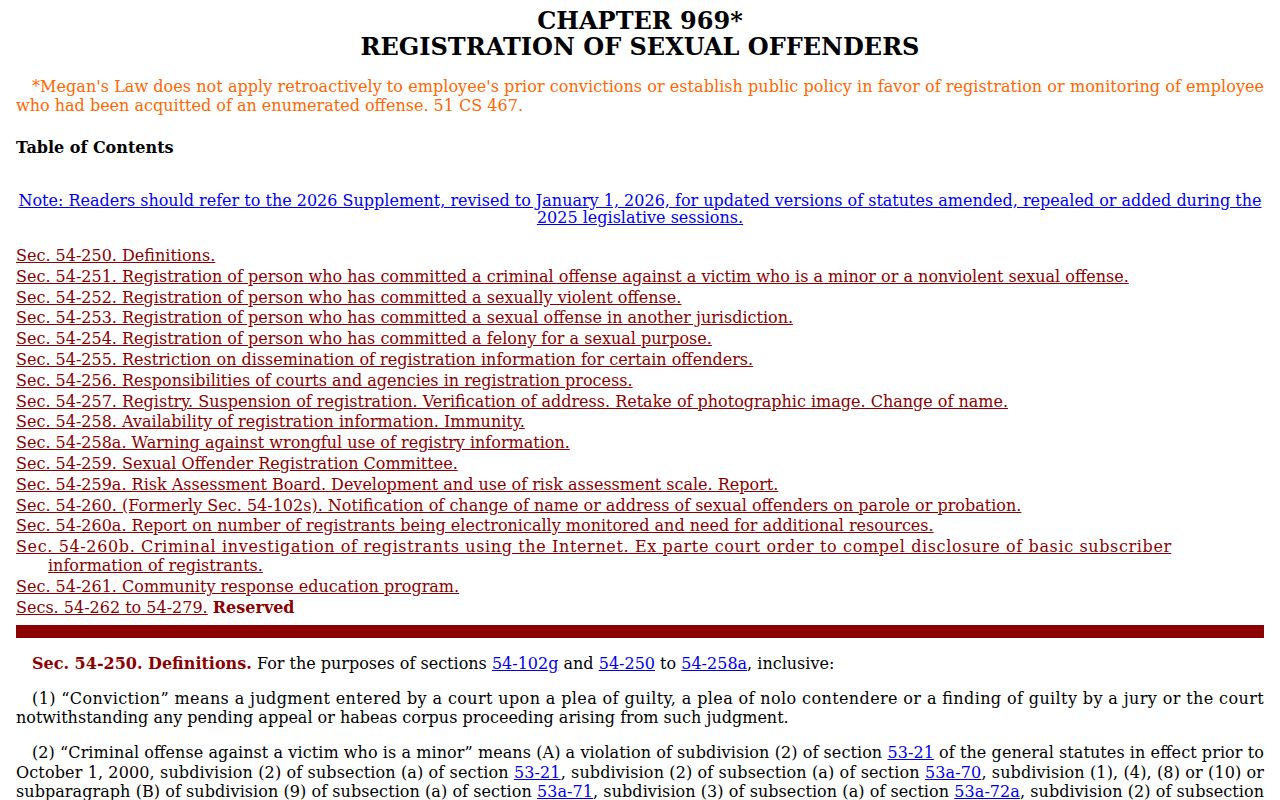
Reading the law beside the live profile helps keep a Hamden registry check within its exact public-safety purpose.
Misuse can be a crime: Do not use registry information to threaten, harass, intimidate, unlawfully discriminate, or promote vigilantism. Connecticut's Chapter 969, including CGS §54-258a, provides consequences for misuse.